Adventures in Isotopy
This series runs in parallel with and complements the Primitives series. Wherein that one catalogs (among other things) the distinct individual forms that emerge when adding incremental complexity to simple circle immersions, this series looks at how a multiplicity of those figures, along with their simpler progenitors, might fill an ambient space, how each is altered by the proximity of the others, how the more varied the elements, the more they resemble something like an ecosystem.
I have a hunch that the complex patterns we associate with consciousness and feeling, values like inside/outside, liberty/duty, approach/withdrawal, individual/collective, peace/conflict, order/chaos, desire/disgust, meaning/hopelessness, all these and more derive directly from and are traceable back to the first physical morphologies that inevitably arose in the advent of something proceeding from nothing. These figures feel like first things, antecedents to river stones, organisms, alphabets, number systems. They resonate with something basic, ancient, fundamental, pre-primal. They are cave paintings in the quantum age.
Bottom line, the felt experience of living in a world that behaves in ways that are described by mathematics with an uncanny preternatural accuracy is astonishing, an always available source of joy.
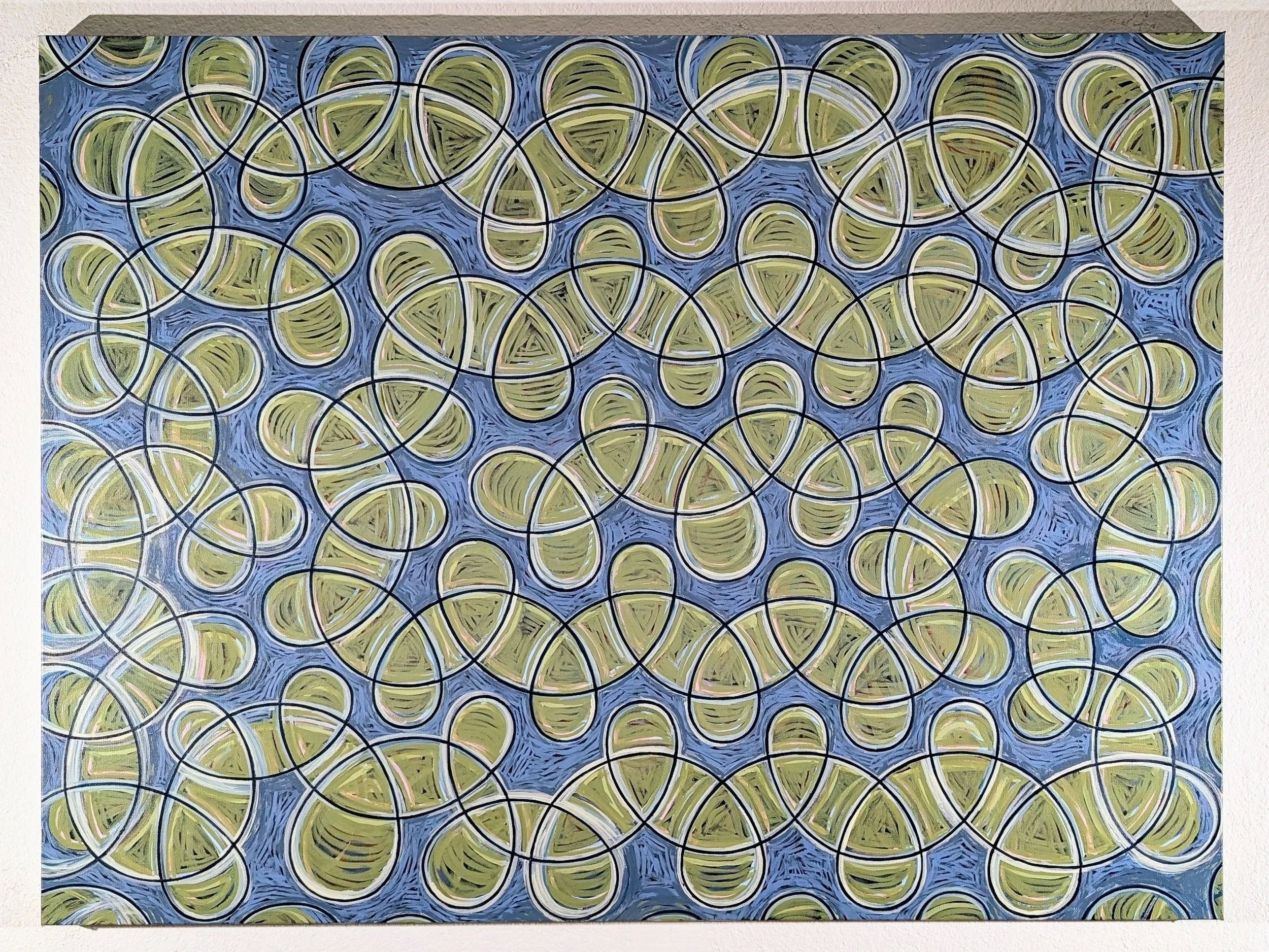
Let some air in (redux) 20260702 36 × 48” acrylic on canvas $987
A circle immersion, yes, but one where every interior loop intersects with the opposite side, shark tooth style, collapsing the halves and zippering them together with stubby digits, spiraling out from one end, there in the center, to the other, an indeterminate distance out of the picture, assuming the spiral pattern continues, which, why wouldn’t it? A syncopated jello jiggle of bulbous seaweed bladders, translucent like the abdomens of fireflies. But also, mosaic tiles like the shattered ceramic collages of the Gaudi benches in Park Güell. Also, cloudy, opalescent gems strung together like Christmas lights. Also, the print whorls on fingertips not quite touching, repeated hall-of-mirrors style in crisscross diagonals. The worm of the world, turning. Math being everything but boring,
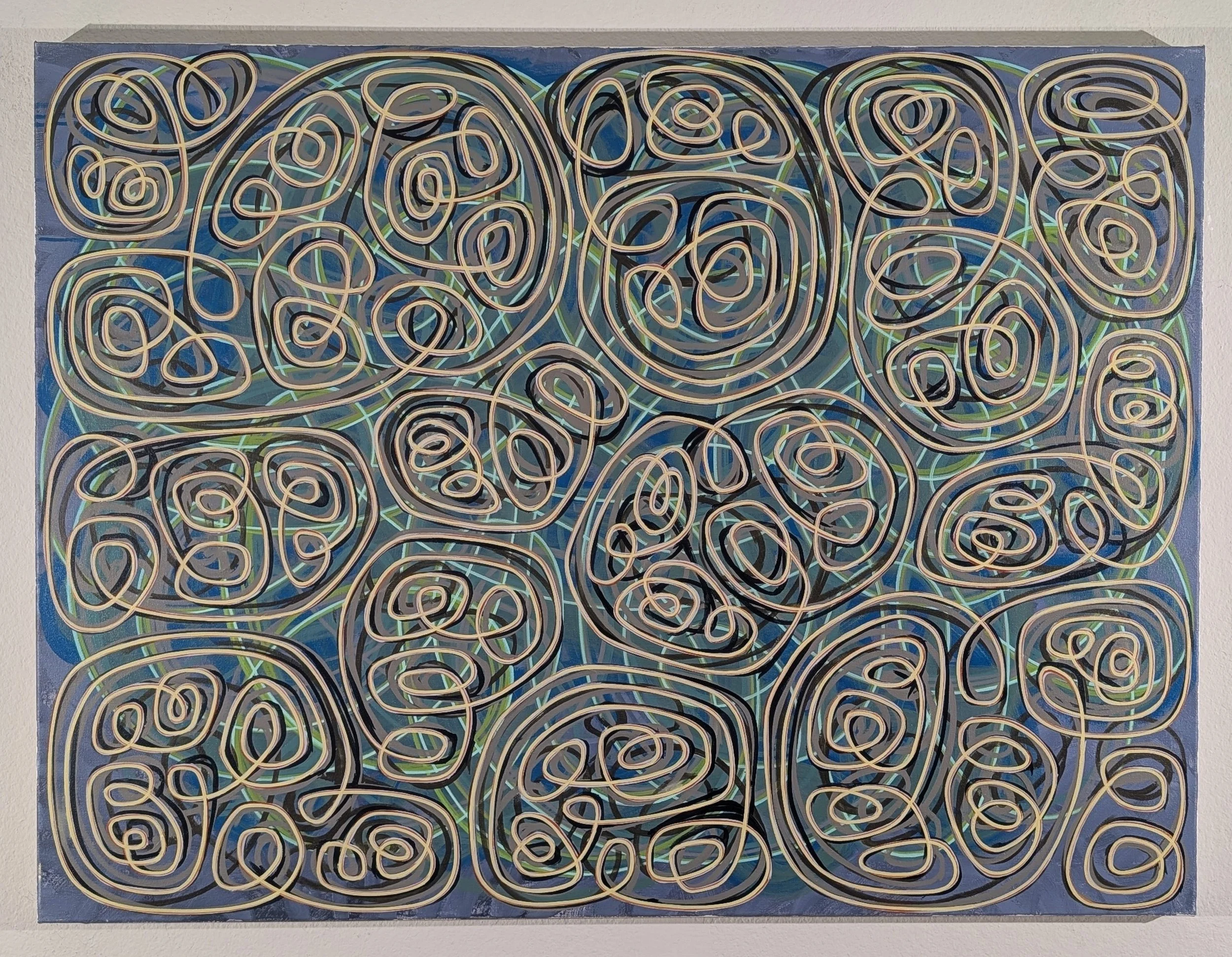
Diverge 20260430 36 × 48” acrylic on canvas $987
This is the fourth of a set of six paintings that explore the way that only and exactly six distinct topologies for monotonal simple-traversal circle immersions with three intersections organize themselves in a finite ambient space. Each type feels and behaves distinctly, the difference mainly being a function of the physical attributes of the basic shapes. The permutation here has two loops at the first level of nesting, one of which contains a second nested loop. It is one of two intermediate steps that walk from the shallowest to the deepest nesting configurations. Apart from those four, the last two ( see “Intermingle” and “Scatter” below) turn the circle inside out, to surprising effect.
Each painting in the set will have a single word in the imperative case as its title, where each title describes the organizational dynamic that gives rise to their distinct geometries and felt environments. They embed, they reflect, they diverge, they contort, they intermingle, they scatter. Sounds to me like a life cycle, but that comparison has it backwards. These older, simpler, and more basic things reflect patterns that we see repeated in the higher levels of abstraction we recognize as life cycles, social structures, mythologies, values, the narratives and attributes we ascribe to persons and their felt experience.
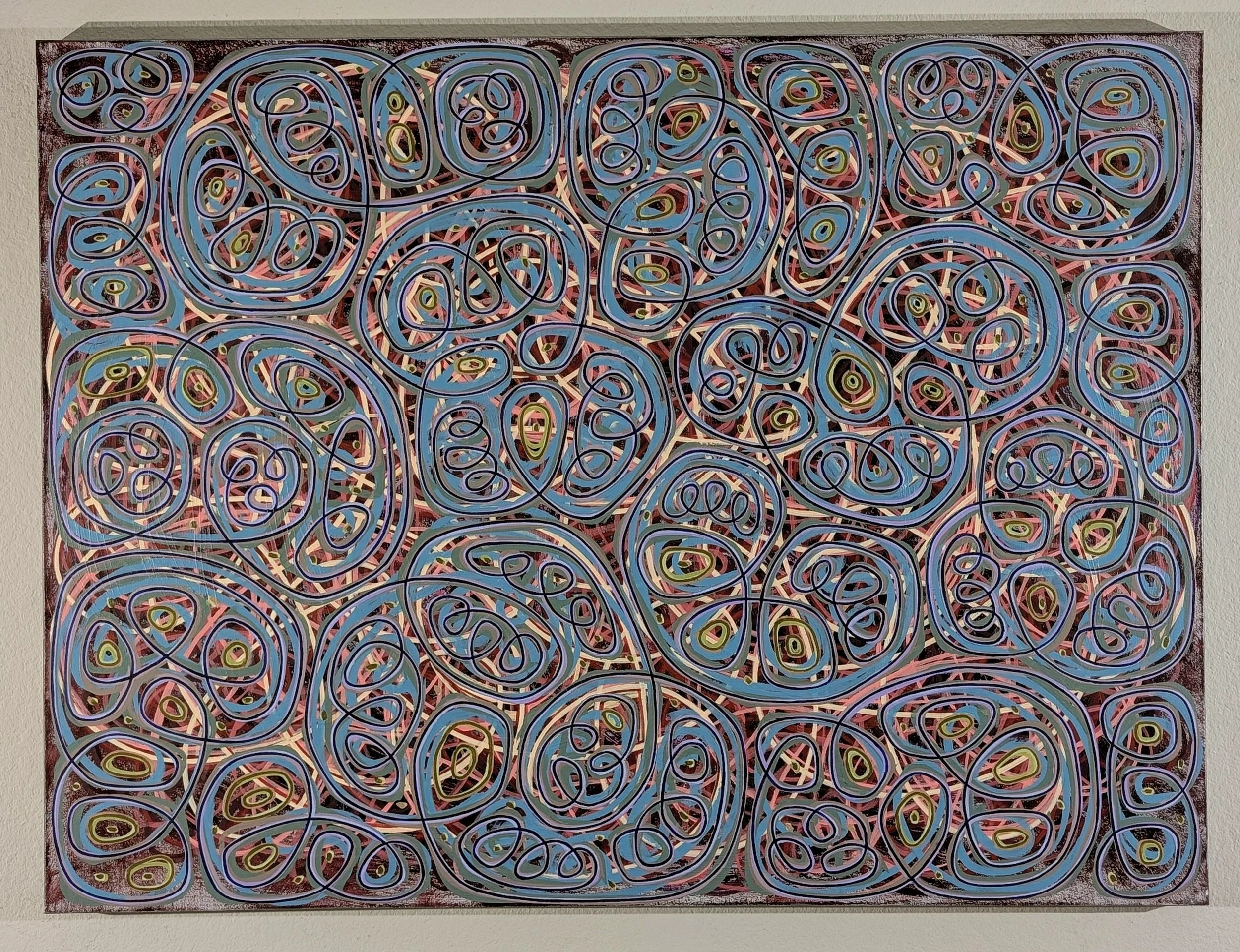
Contort 20260427 36 × 48” acrylic on canvas $987
The primary figures featured here have three intersections where all the consequent loops are clustered together at the first nesting level. This is the most pliable of the circle immersion types so far, one which will only become more so as the number of intersections increases. The figures tend to elongate and collapse into something like peas in a pod, gnashing teeth, or alternating cogs when encountering space constraints. Which is inevitable, because even infinite space behaves locally as if finite.
I started thinking about this while using a digital infinite canvas application to build out the map of how these two dimensional linear figures vary and evolve (see the “Primitives” tab), and found that the abundance of varieties emerge so fast that they exceed a two dimensional substrate’s ability to contain them without a dramatic shift in scale that would make them too small to see individually, or without dramatic hyperbolic folding. So it seems like a given space of x dimensions is not big enough to contain all of the things of x dimensions that could theoretically fill it, even at the limit of one instance per type of thing. At least, not without big scale shifts or significant warping. So space behaves locally as if finite, whether it fundamentally has limits or not.
The colors are intentionally trippy, in keeping with the feeling of looking through the dim lattice-like foreground at this looming and luminous Leviathan suspended behind it, two distinct paradigms in uneasy concord.
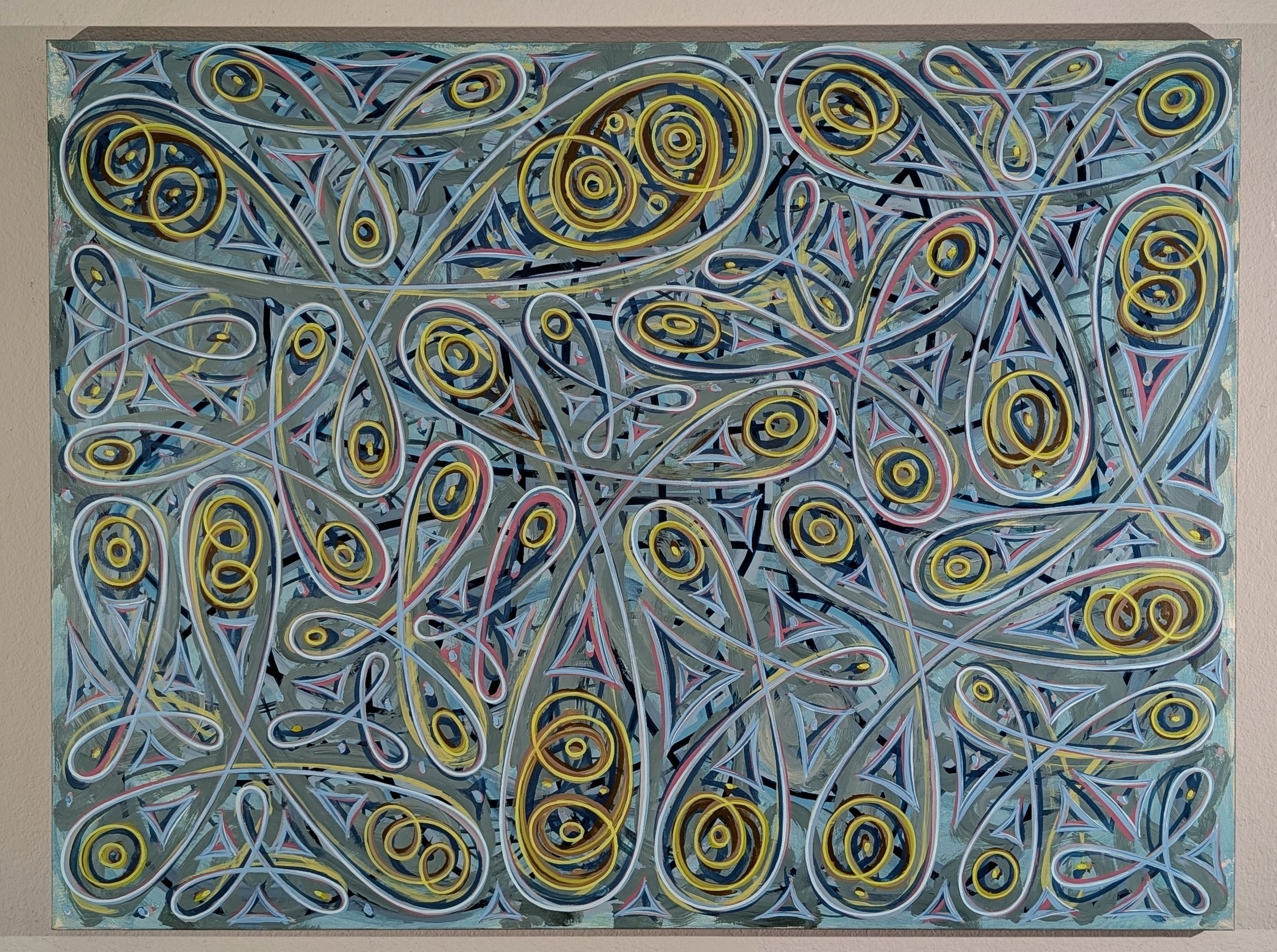
Scatter 20260423 36 × 48” acrylic on canvas $987
This shape, a planar trifolium, is the most rigid of the circle immersion types I’ve yet encountered in the wild. That set of three intersections in the center, that concave arc triangle, doesn’t afford any wiggle room. The loops have to trade relative size for play. It changes the whole dynamic of how things fit together and, in so doing, contributes so much to the expanding visual grammar. Peacock plumes, insect wings, pinwheels, propellers. If you think of the circle as a substrate for anything that can happen, turning it inside out like this turns one into three. It’s like a propagation mechanism. Beyond that, how can it feel both spectral and infused with joy?
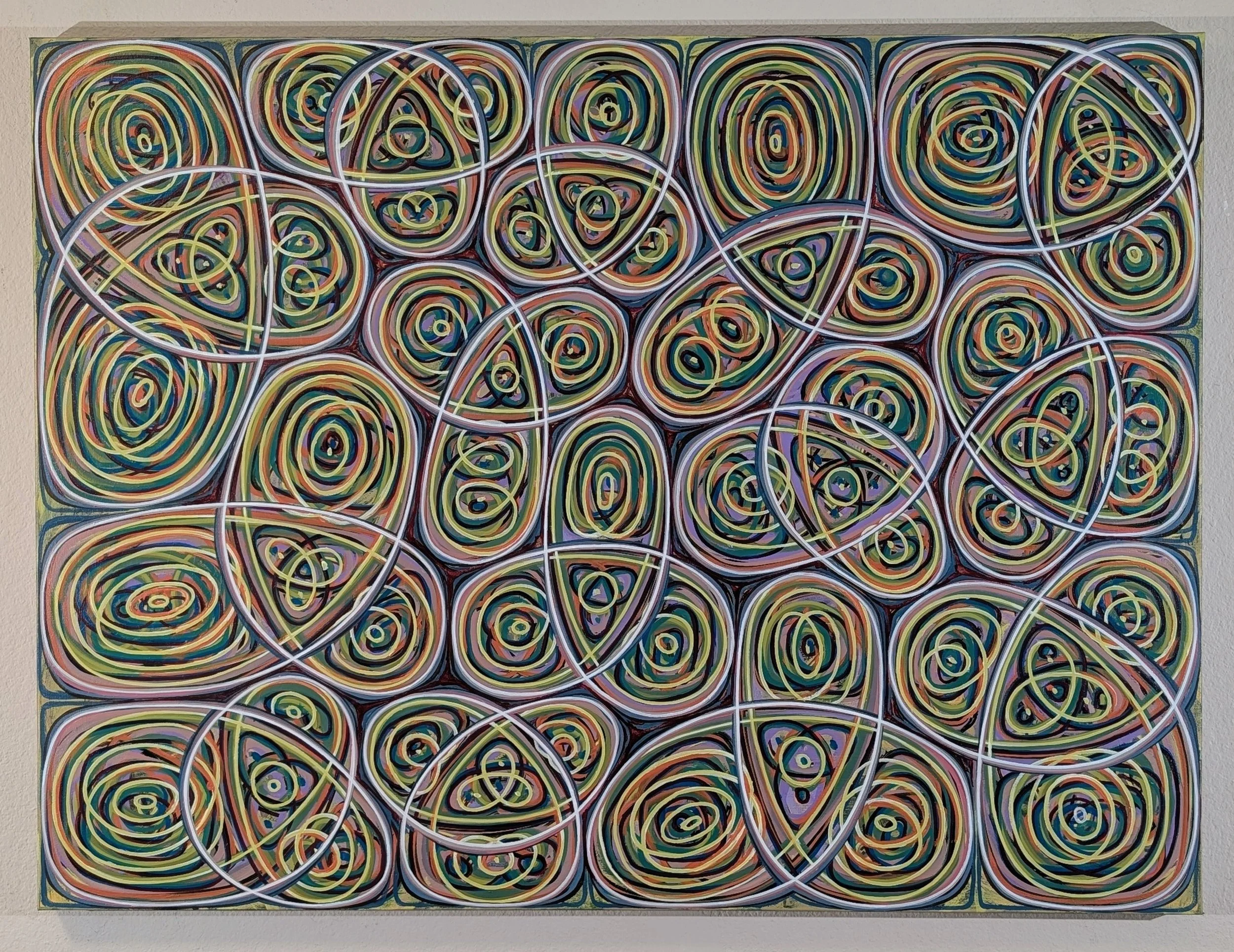
Intermingle 20260415 36 × 48” acrylic on canvas $987
The organizing figure is a trefoil without any of the over/under data that would be relevant to knot theory. I’m keeping things strictly planar, with the caveat that direct experience of true two-dimensionality is wholly inaccessible to us. Each trefoil instance has an inner aspect gravitating towards symmetry, and an outer aspect warped to the available space, pushing and pulling in response to the presence of others. Each compartment is a shallow alcove of lantern glow, a translucence. Molecules, plankton, fingerprints, hieroglyphs. Also, stunned monkey faces.
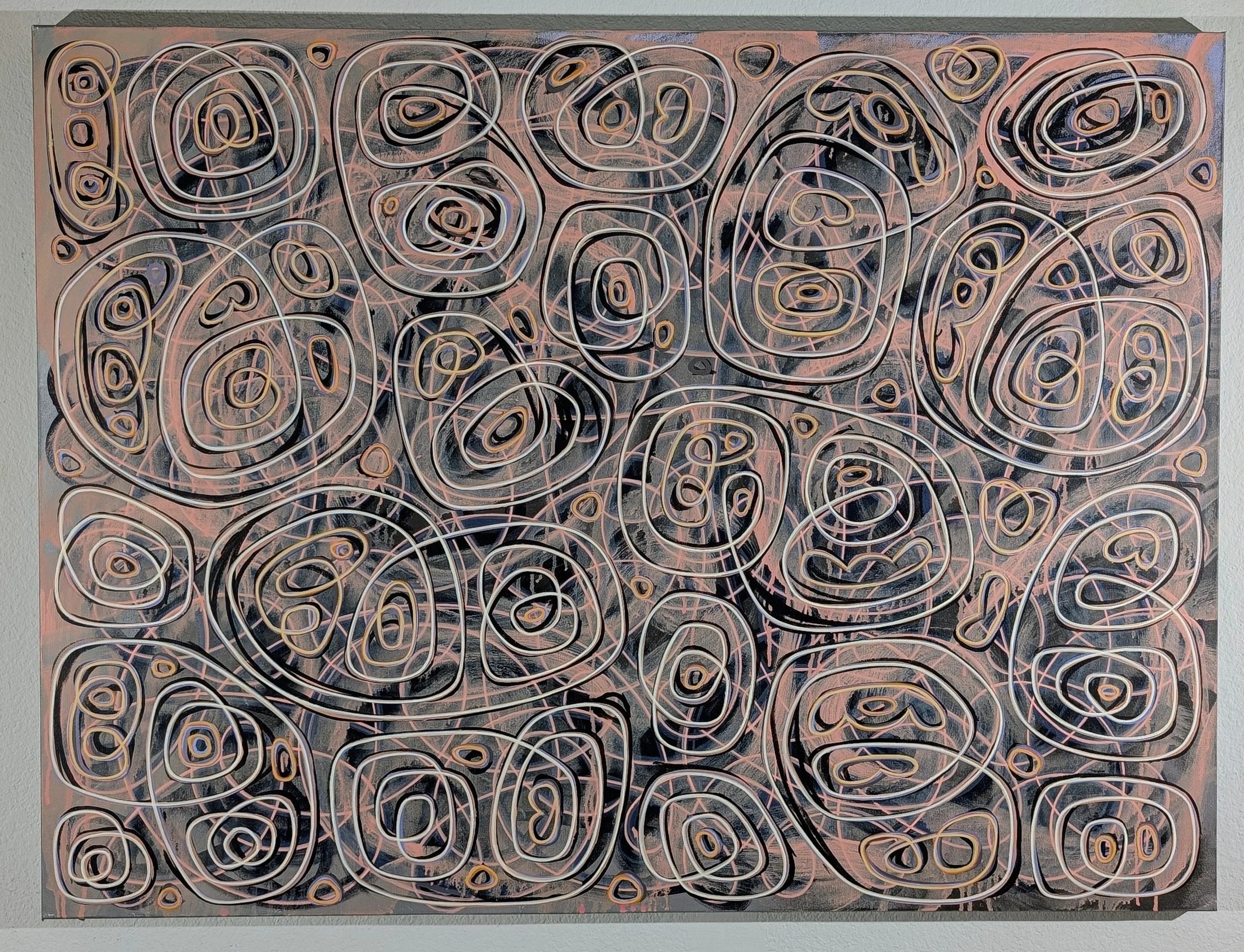
Brace for impact 20260407 36 × 48” acrylic on canvas $987
The predominant figure here is a simple circle immersion where the interior loops are fully nested. There are also examples where the interior loops are adjacent, and simpler forms. The larger figures look like they are hovering off a screen being hit by harsh projected light. But also like they are floating in some viscous suspension, lymphocytes, a cytokine flurry. Up close, there is a lot of surprising color stuff peeking past the edges.
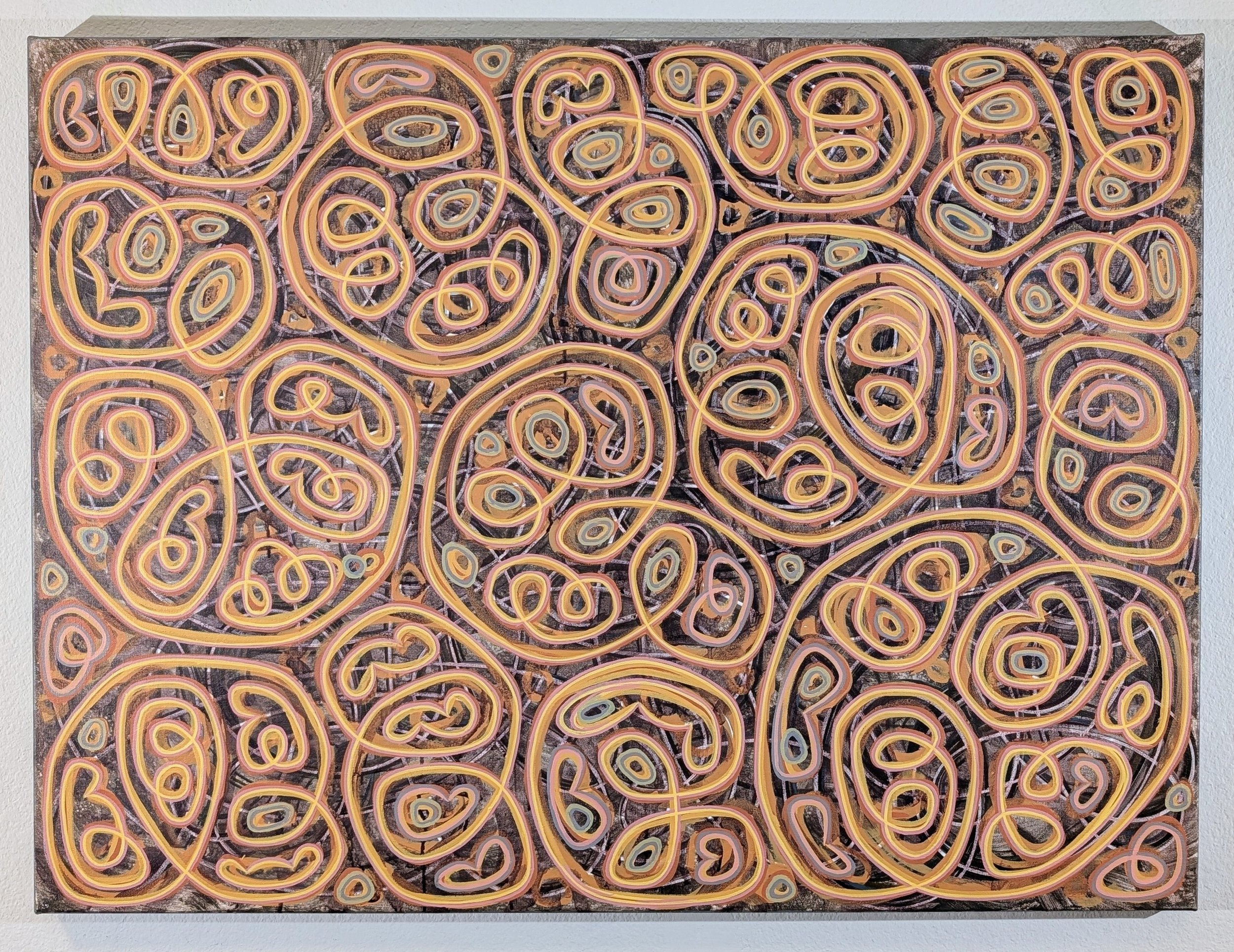
Overlap the magisteria 20260404 36 × 48” acrylic on canvas $987
The evolutionary biologist Stephen Jay Gould contended that Science and Religion constituted non-overlapping magisteria. He asserted that the contentions of each were wholly inaccessible to the tools and methods of the other. And I agree with that. Nonetheless, I suspect that the things we believe derive in no small part from the underlying physical structures of our shared reality. Dualities are observable, and also serve as organizing principles in most spiritual systems. This doesn’t seem like two completely unrelated things.
The background in this painting is continuous and coherent. The foreground figures both acknowledge and diverge from the underlying structure, a new settlement built on the ruins of an older city. Simple circle immersions with two intersections where the inner loops are adjacent rather than further nested, drifting cirrus above a darker and grander landscape. Are they unrelated?
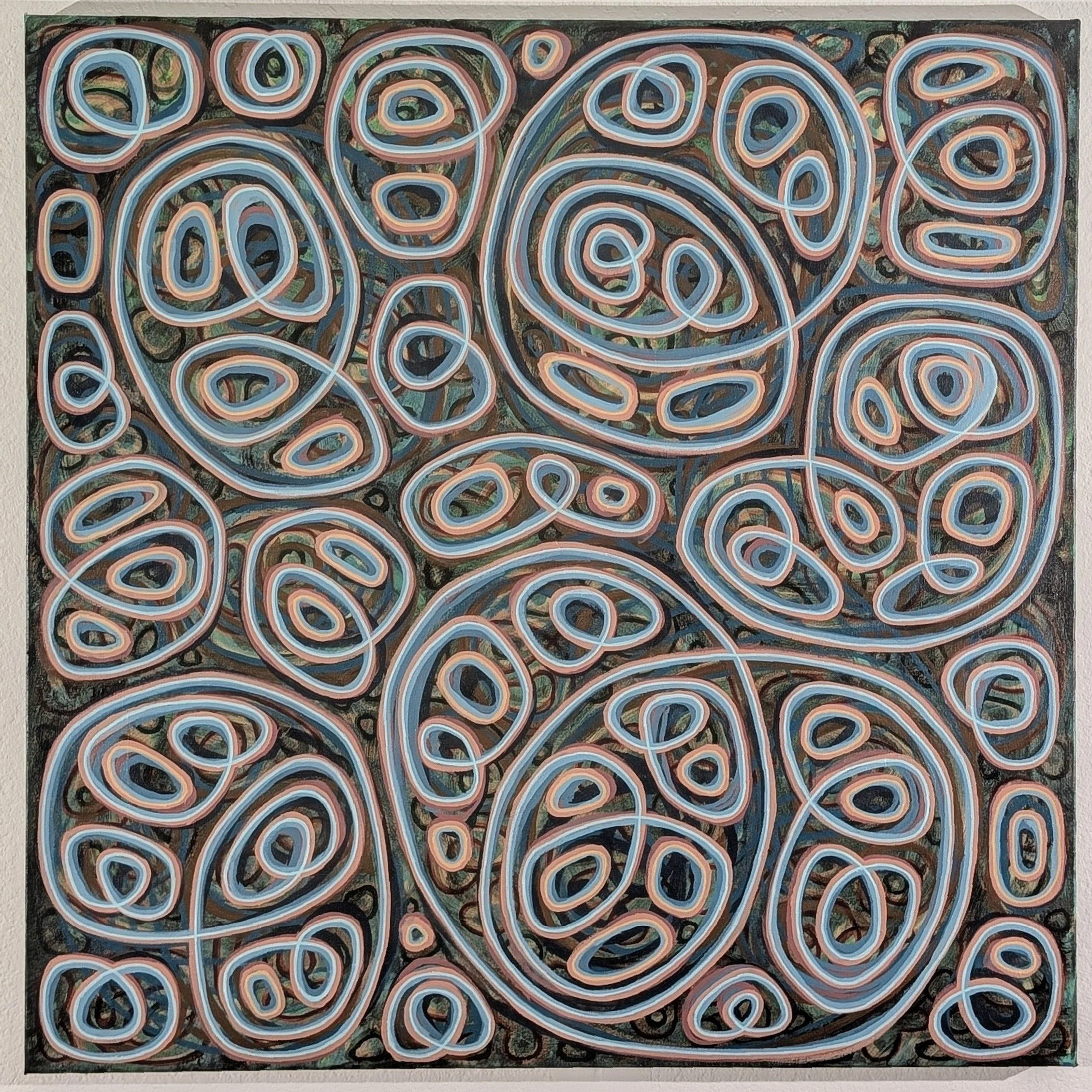
Turn over a new rock 20260402 36 × 36” acrylic on canvas $610
Smooth edges like rivers stones, except fashioned by opposite means, warped from a higher symmetry as a consequence of crowding in a finite space rather than starting as jagged edges rounded off by erosion. “Starting” would be wrong. Beginnings happen largely in curves and spirals, endings in polygons. A mud flat, deposited by swirling currents and eddies, cracks into polygons as it dries. Rocks cooled from magma crumble in chunks. Crystals form as energy dissipates. Creation is curved, destruction angular. I’ll remind you that we live in boxes.
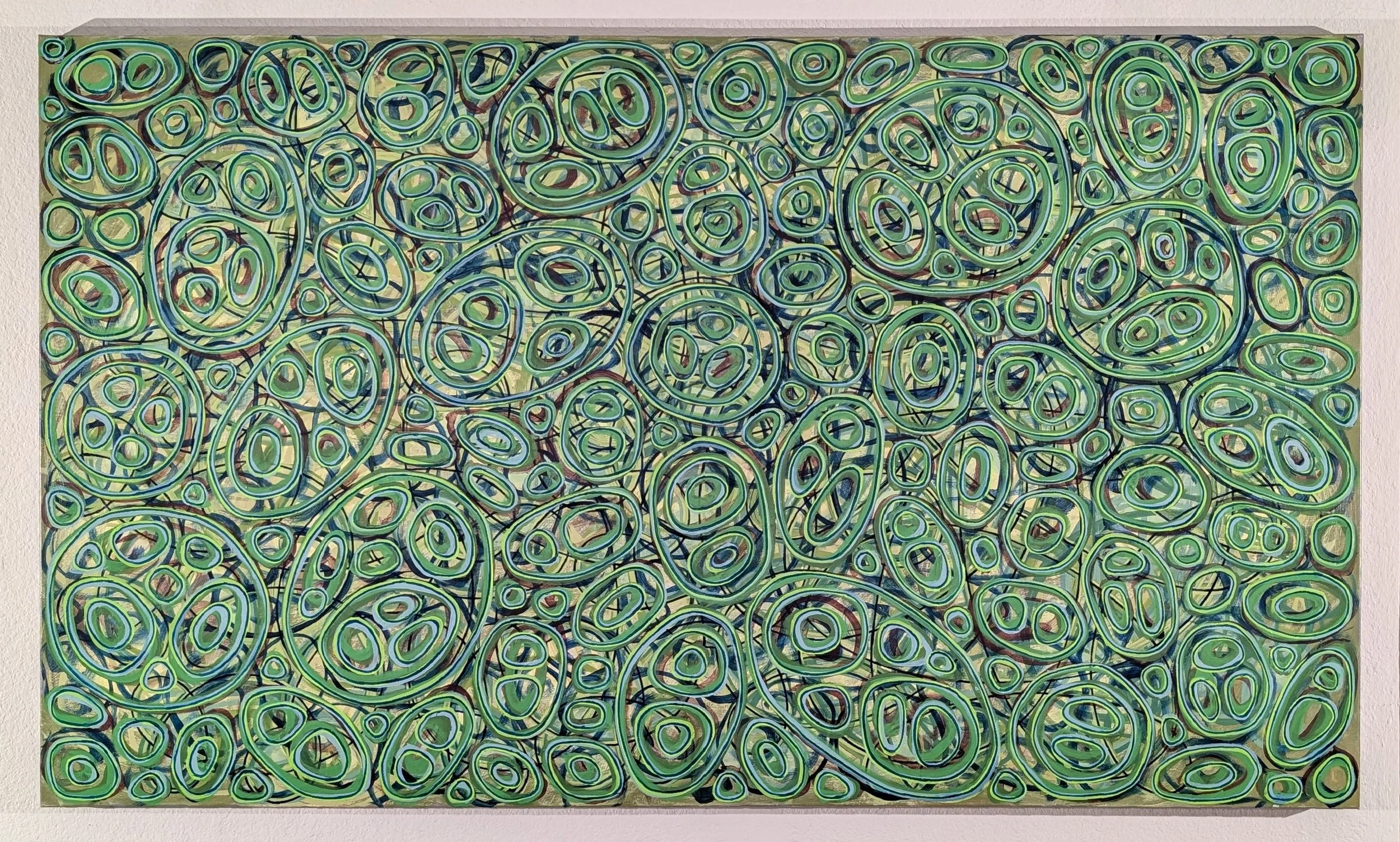
Try to not see faces 20260401 36 × 60” acrylic on canvas $1,597
Since I started painting single loops more than a decade ago, I never felt like I had a compelling reason to include more than one. Then I started the “Primitives” series, collecting simple circle immersions and classifying them from sort of a phylogenetic perspective. And I thought, what might happen if I were to take a single variety and populate a finite space with it? So I did. And three things happened. First, containment. Wheels within wheels. Second, a new dynamic in the monotonal curves that look like what happens when bending a wire coat hanger. Shallow curves taking sudden acute turns. Fills the space better. Third, faces. And once you see them, even the ones that don’t look like faces become faces, insectoid, alien, otherworldly. Wheels within wheels, all covered with eyes.
If you’re here, you’ve reached the beginning of the series, and presumably seen how each of these is an incremental step on a trajectory toward a complexity that retains something like homeostasis even as it increases. I’m not woo woo enough to ascribe intent to any of it, but the most beautiful things the universe does involve devising systems of great complexity that manage to sustain themselves for a time. My daily practice is an embodiment of this perspective.